Someone had to write the first bars.
Every movement in this story was started by people who decided the economy could be rewritten. At the centre stands one composer-in-chief; around him, a movement that has been building for a decade. This vision is, in its own words, of all of us, for all of us.
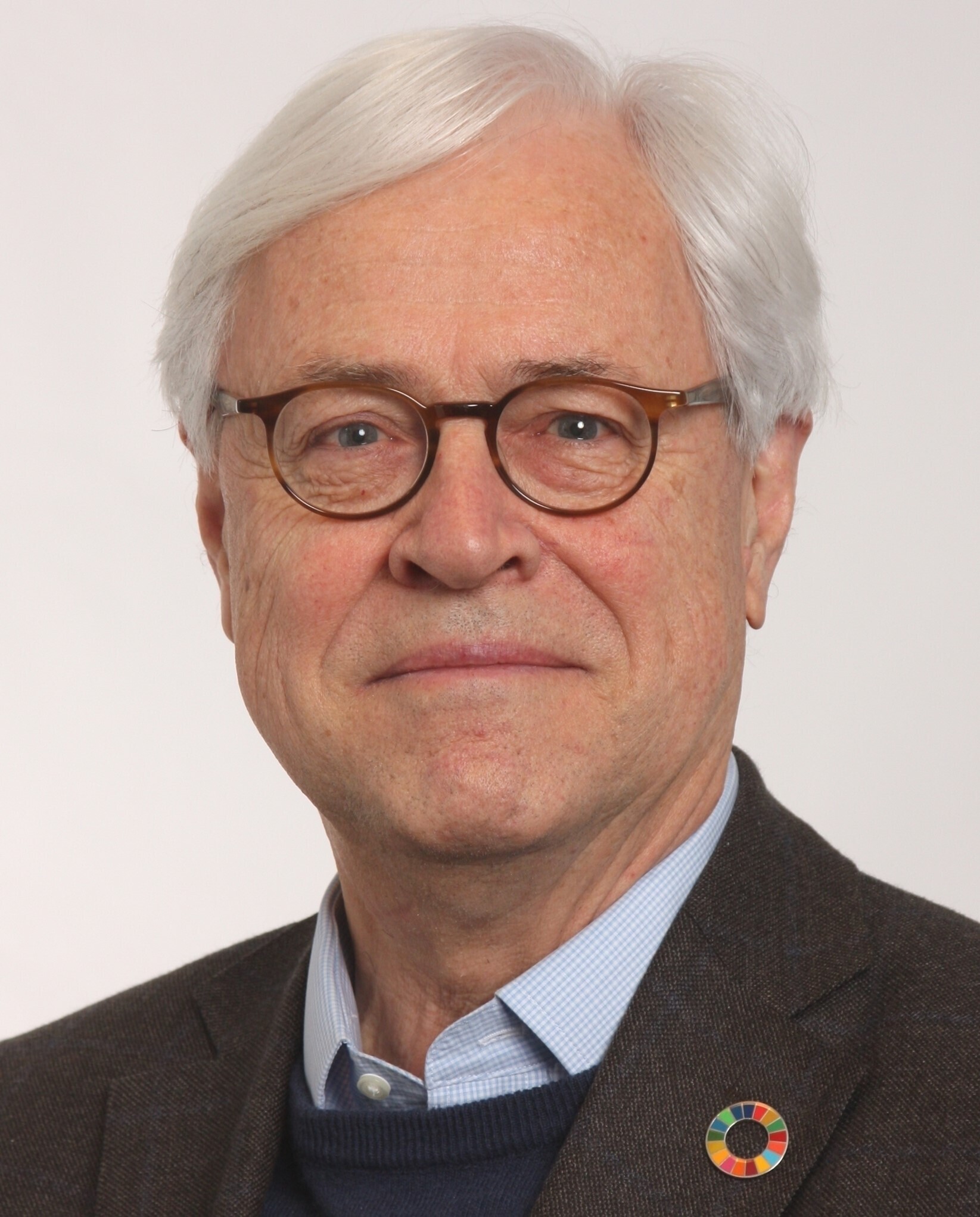
Herman Mulder's career is the thesis in miniature: a finance insider who concluded the system was unfit for purpose, then spent the rest of his working life rebuilding it from within.
Born in Amsterdam in 1946, he trained as a lawyer at Leiden and as an economist at Erasmus, later studying at INSEAD. He describes his own life in two halves — a “Black period” and a “Green period.” Through the first, he rose through ABN AMRO to head its global structured finance and then, until 2006, to serve as director-general for group risk management — two decades at the centre of global banking, where he also founded and first chaired the bank's own foundation. A challenge from civil society became his ethics wake-up call, and the second half of his career began.
What followed was not a retreat from finance but a campaign to re-norm it from the inside:
Co-initiator of the Equator Principles — the first voluntary, global environmental and social code for the financial sector, since adopted by institutions worldwide.
Board member and then Chairman of the Global Reporting Initiative, through its landmark G4 era of sustainability reporting.
Independent member of the Dutch NCP for the OECD Guidelines for Multinational Enterprises, mediating some of the period's most difficult disputes between business and civil society.
The throughline matters more than the titles: a risk-and-finance professional who turned voluntary codes into industry norms, again and again. The whole TrueSymphony argument — that finance can re-norm itself — is something he has already done, in miniature, several times over.
Nothing is impossible, particularly when it is inevitable.
He chairs the cluster of organisations he co-founded — True Price Foundation, the Impact Economy Foundation and SDG Nederland — and serves as an adviser or board member to Social Finance NL, the TEEB advisory board, Het Groene Brein, UN Global Compact Netherlands and the Worldconnectors, among others.
He co-initiated the SDG-Investing Initiative — “Building Highways for SDG Investing” (2016), the work from which the blended-finance track that became the Symfonie funds directly grew; held a fellowship at Nyenrode Business University and chaired its Corporate Governance Institute; sat on the board of Utz Certified; and advised the World Business Council for Sustainable Development on climate.
Knight in the Order of Oranje-Nassau (2005), promoted to Officer (2017); named among the “100 most influential people in finance” (2007).
Beyond the roles that defined his career, he has advised, chaired or supported a long list of further organisations — among them Oxfam Novib, the Natural Capital Coalition, the International Integrated Reporting Council, the Tällberg Foundation and Earth Charter International. The breadth is the point: this is a life spent stitching together the institutions of a fairer economy.
A symphony is the work of an orchestra.
TrueSymphony has been shaped by a wide and growing coalition: the foundations and institutes Mulder built, a network of academic economists and governance scholars, and a circle of allied organisations working on stakeholder governance and the reinterpretation of economics for an age of consequences. The principle is clear: this is a coalition, not a personality.
The composers of the earliest movements are named here. The composers of the later ones are not yet born.
Not name-drops. Evidence that finance can be made fit for purpose.
The authority of this project does not rest on a single biography. It rests on a lineage of institutions that demonstrate, piece by piece, that voluntary reform of finance is not naïve but proven — because, in piece after piece, it already has been.